Tokenise, invest, borrow, and earn yield on real-world assets - verified once, executed on Arbitrum, and usable across any chain with a single source of truth.
OpenAssets is not just another tokenization platform; it is a capital formation engine built for Arbitrum and broader EVM support. We believe the true potential of Real-World Assets (RWAs) remains untapped because they are currently treated as static digital certificates. OpenAssets changes the paradigm by transforming off-chain cash flows,starting with trade receivables into dynamic, credit-enabled financial primitives.
By anchoring the entire lifecycle, from compliant issuance to secondary market settlement into a deterministic on-chain state machine, we allow RWAs to move at the speed of DeFi.
The Issue: Capital is held hostage by maturity dates.
The Problem: Traditional RWA tokens are "maturity-locked." Once an investor purchases a tokenized invoice or bond, their capital is effectively "frozen" for 30, 60, or 90 days.
The Impact: This creates a massive opportunity cost. Investors cannot react to market volatility or pivot to new opportunities because their RWA is "dead weight" in their wallet it has value, but no velocity.
The Issue: "Last-Holder-Takes-All" logic destroys secondary markets.
The Problem: Most on-chain yield models pay whoever holds the token at the exact moment of maturity. If an investor holds an asset for 99% of its duration but needs to sell a day before settlement, they lose 100% of their accrued yield to the buyer.
The Impact: This encourages "Yield Sniping" and penalizes long-term holders. It makes secondary markets toxic, as there is no mathematical incentive to provide liquidity mid-cycle, leading to stagnant, illiquid RWA ecosystems.
The Issue: Collateral is siloed and non-composable.
The Problem: To borrow against an RWA today, you must usually move your asset into a specific, siloed lending protocol. This creates "Liquidity Islands" where your collateral is only recognized by one lender.
The Impact: This forces users into risky, high-friction migrations. If you want better terms elsewhere, you have to withdraw, bridge, or transfer your collateral, losing time and paying excessive gas. There is no "Universal Credit" identity that allows RWA collateral to be portable across the Arbitrum and EVM ecosystem.
OpenAssets introduces a deterministic lifecycle for RWAs on Arbitrum, engineered to ensure that every stage, from capital formation to final settlement is mathematically optimized for liquidity and institutional trust.
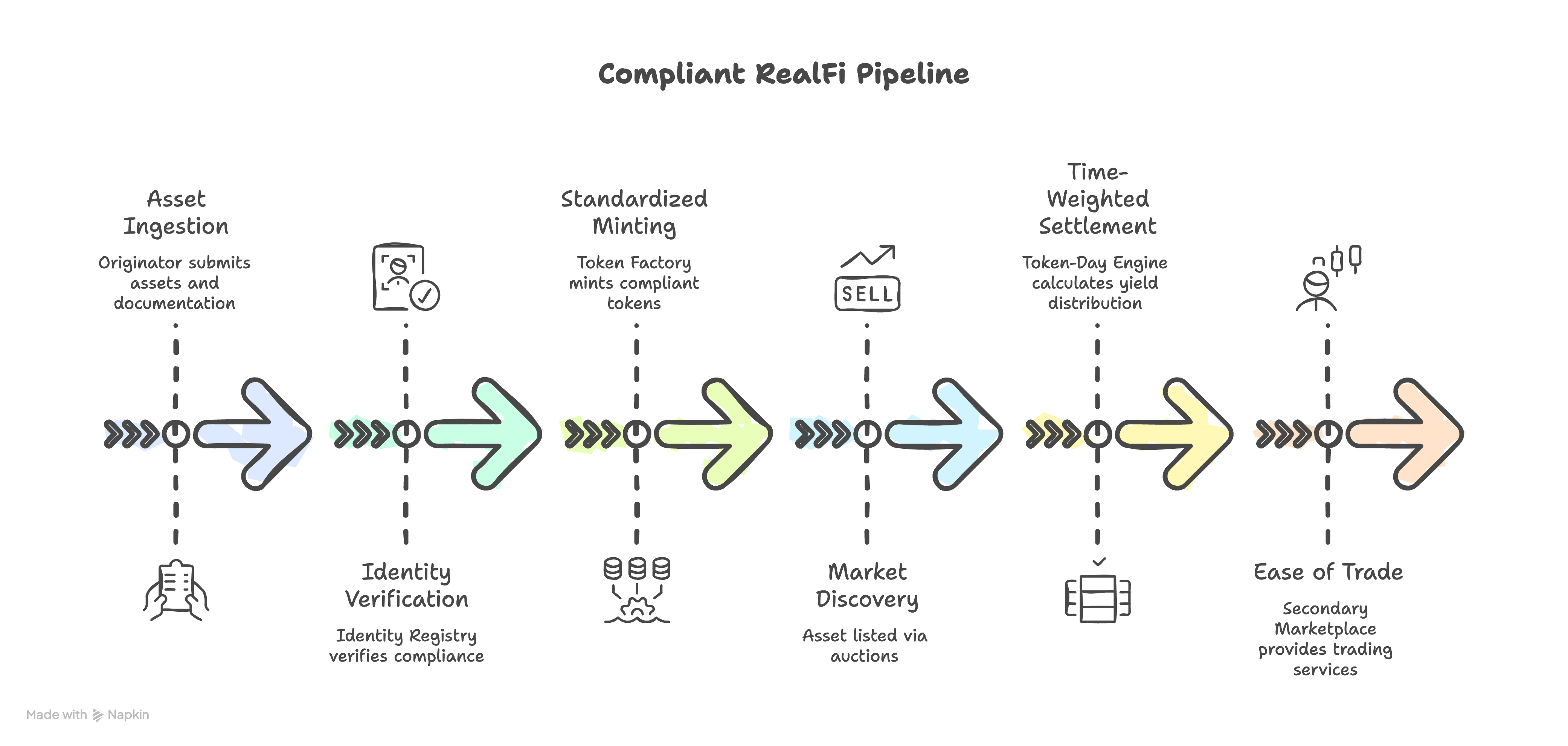
We move beyond simple asset "wrapping" by adopting the ERC-3643 (T-REX) standard. By embedding Identity Registries and permissioning logic directly into the token's DNA, we ensure that every invoice remains compliant across its entire on-chain journey. This creates a non-reversible state machine on Arbitrum that offers the institutional-grade auditability and custody modeling required for sovereign-level RealFi.
We have pioneered a capital-efficient acquisition model that turns stARB into a productive collateral engine. By utilizing stARB as primary collateral, our Leverage Vault automatically harvests native staking yield to service the loan interest, of the position created to buy any RWA. This creates a self-amortizing lending strategy where investors maintain leveraged exposure with net-positive yield outcomes, deep-linking RWA utility with Arbitrum's core DeFi liquidity.
We introduce the Open Access ID (OAID), a universal credit identity that fundamentally decouples asset custody from capital utility. By securing assets within our Solvency Vault, RWA collateral is transformed into a portable credit line. This allows users to "Deposit Once, Borrow Everywhere," tapping into multiple Arbitrum and EVM lending markets and yield optimizers simultaneously without moving the underlying asset.
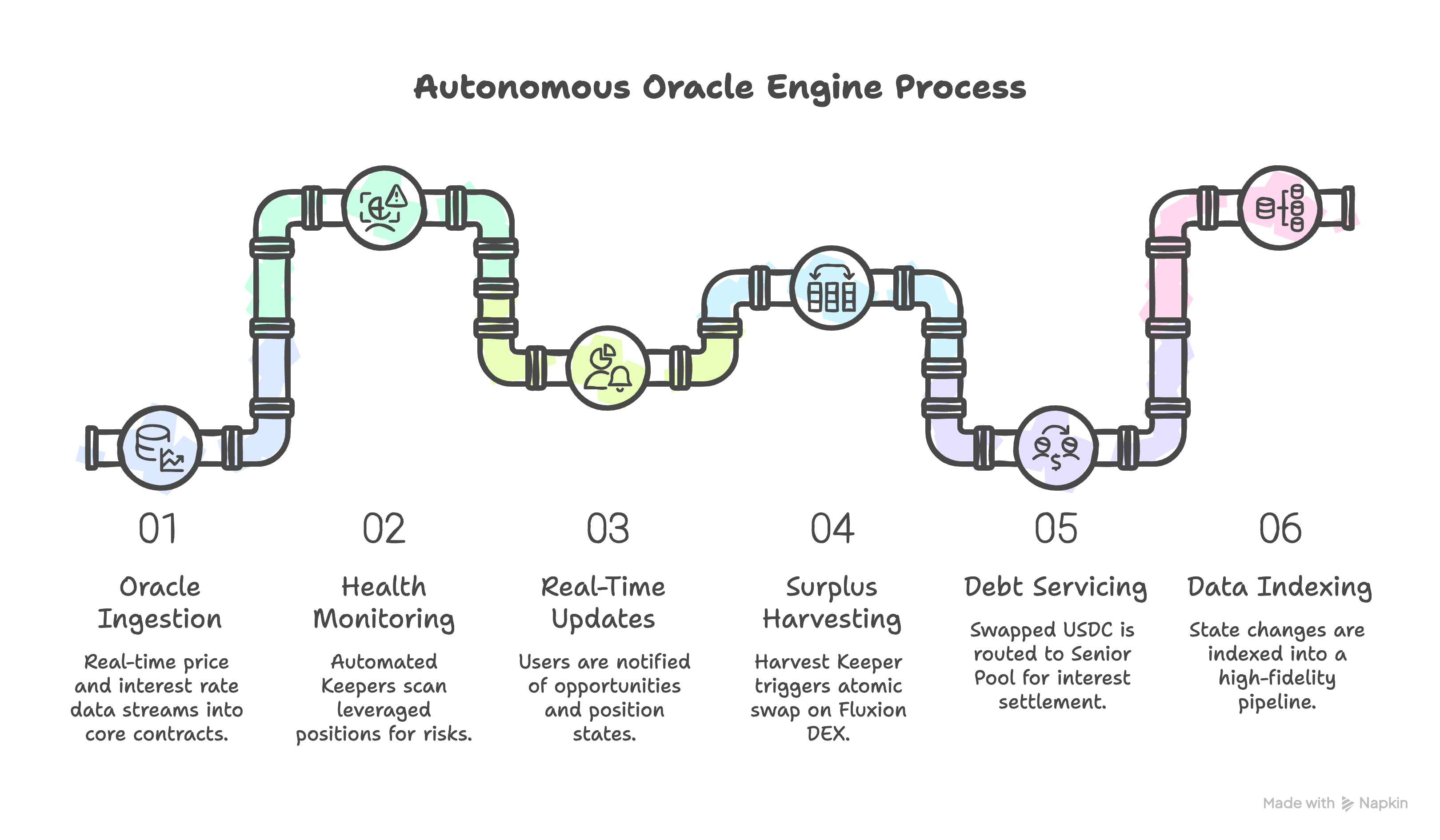
The protocol is governed by an Event-Driven Coordination Layer that synchronizes Arbitrum-native price feeds with off-chain asset maturity. Our Automated Keeper System acts as an on-chain autonomous agent continuously monitoring Health Factors and executing interest-servicing swaps on the DEX's (mocked for sepolia ). This replaces manual asset management with a deterministic data pipeline, ensuring protocol solvency via real-time oracle integration.
To fuel a healthy secondary market, we’ve built an Algorithmic Yield Engine that tracks ownership duration down to the second. By distributing returns based on "Token-Days," we mathematically eliminate "Yield Sniping." This ensures compliant yield distribution where every participant,from primary buyers to secondary traders is rewarded precisely for their specific duration of risk.
Issuance • Discovery • Leverage • Credit • Settlement
Official Website: openassets.xyz
Interactive System Sitemap: How it Works
About the Team: About Us
Client (Frontend): TOA-Client
Server (Backend/Contracts): TOA-Server
X (Twitter): @TheOpenAssets
Discord: Join Community
Telegram: Chat Hub
2026 OpenAssets.
All rights reserved.
Built with precision for the Arbitrum Network ecosystem.
Arbitrum Yield Strategy Study:
Researched Arbitrum-native yield primitives and designed the stARB-based surplus yield harvesting mechanism, enabling automated interest servicing and sustainable yield routing for credit positions without requiring manual intervention.
Architecture Mapping:
Designed the OpenAssets State Machine to manage the full lifecycle of tokenized real-world assets:
Draft → Registered → Issued → Active → Settled
Defined a scalable monorepo architecture using Hardhat for smart contract development and deployment orchestration, and NestJS for backend indexing and automation services, ensuring modularity, deterministic deployments, and production readiness.
Protocol Core Development:
Developed and thoroughly tested a suite of 18+ interconnected smart contracts forming the foundation of the protocol, including:
AssetRegistry for asset lifecycle management
YieldVault for pooled capital allocation and yield accounting
OAIDRegistry for global credit identity and borrowing capacity tracking
Primary and Secondary marketplace contracts for issuance and liquidity
All contracts were optimized for secure, modular deployment on Arbitrum.
Compliance Integration:
Implemented ERC-3643 compliant identity and permissioning infrastructure, including IdentityRegistry, TrustedIssuersRegistry, and AttestationRegistry, ensuring only verified and authorized participants can interact with regulated RWA tokens.
Deployment Orchestrator:
Developed a fully automated, idempotent deployment orchestrator capable of deploying and linking the entire 18-contract protocol stack, managing role assignments, contract permissions, and interdependencies in a single deterministic execution.
Leverage and Yield Integration:
Built the LeverageVault modules to support atomic stARB/USDC interactions, enabling automated yield servicing, efficient leverage management, and sustainable credit servicing using Arbitrum-native liquidity.
Real-Time Indexing Infrastructure:
Developed a high-performance event indexing engine using NestJS, which listens to on-chain events and reconstructs protocol state into a MongoDB cluster, enabling sub-millisecond frontend data access without requiring direct blockchain queries.
Automated Keeper Infrastructure:
Implemented autonomous backend services including:
Health Monitor: Continuously monitors loan health, collateralization levels, and liquidation risk
Harvest Keeper: Automates stARB yield harvesting and interest servicing cycles to maintain protocol solvency and operational efficiency
Credit Abstraction Layer:
Implemented the OAID indexing and credit abstraction system, enabling global credit tracking across multiple asset positions and ensuring accurate borrowing capacity and risk evaluation.
Institutional-Grade Dashboard:
Developed a production-ready frontend using Next.js 14 and Tailwind CSS, providing comprehensive visibility into:
Asset lifecycle status
Yield performance
Credit utilization
Vault and marketplace activity
Leverage and Yield Simulator:
Built the stARB leverage simulator, allowing users to model leverage scenarios, visualize projected APY, and analyze position health and liquidation risk before committing capital.
Marketplace and Auction Interface:
Developed a real-time bidding interface for Uniform-Price Dutch Auctions, integrated with Redis WebSocket infrastructure to provide instant updates, transparent price discovery, and efficient investor participation.
End-to-End Protocol Testing on Arbitrum Sepolia:
Conducted full lifecycle simulations validating:
Asset registration and issuance
Investor participation via primary auctions
stARB-based yield servicing and leverage flows
Secondary market trading
Final USDC settlement and asset closure
These tests confirmed protocol stability, accuracy, and production readiness.
<p>During the three-week hackathon, we designed and built a full-stack RWA credit and yield protocol on Arbitrum, covering smart contracts, backend infrastructure, and frontend systems. We began by defining the OpenAssets lifecycle state machine (Draft → Registered → Issued → Active → Settled) and designing a modular monorepo architecture using Hardhat and NestJS to ensure scalability and deterministic deployment. We engineered and tested a suite of 18+ interconnected smart contracts, including the AssetRegistry, YieldVault, OAIDRegistry, and marketplace contracts, with integrated ERC-3643 compliance to ensure only verified participants can interact with regulated assets. We also developed an automated, idempotent deployment orchestrator capable of deploying and linking the entire protocol stack in a single execution. On the backend, we built a high-performance NestJS indexing engine that listens to on-chain events and reconstructs protocol state into MongoDB, enabling sub-millisecond frontend performance, along with automated keeper services to monitor protocol health, manage credit headroom, and service yield cycles. Finally, we delivered a production-grade frontend dashboard using Next.js 14 and Tailwind CSS, including asset lifecycle tracking, marketplace bidding with real-time updates, and leverage and yield simulation tools. The entire protocol was fully integrated and tested end-to-end on Arbitrum Sepolia, validating asset issuance, investor participation, credit tracking, yield servicing, and final settlement, supported by comprehensive documentation and walkthrough demonstrations.</p>
<p>Bootstrapped</p>

